TOEFL 2026: A Clear and Simple Guide to the New Exam Format


Introduction to the TOEFL iBT 2026 Reform
Starting in January 2026, the TOEFL iBT will introduce significant changes. These updates are not cosmetic — they affect how the exam is scored, how questions are presented, and how your performance is evaluated.
In this article, I want to help you understand the new TOEFL in a simple and practical way, without unnecessary technical language, so you know exactly what is changing and how to prepare.
Why the Change?
The primary reason for the TOEFL reform is to ensure the test remains relevant and effective in evaluating English proficiency. With globalization and technological advancements, the way we use and interact with English has transformed. The updated exam seeks to address these changes, providing a more accurate measure of a candidate's ability to function in diverse settings.
1. What is changing in the TOEFL 2026?
The TOEFL will still test the same four skills:
- Reading
- Listening
- Speaking
- Writing
However, how these skills are tested is changing significantly. The new version of the exam introduces several key updates designed to better reflect real-life language use and improve the overall testing experience.
- A new scoring scale (1–6): Scores will now be reported on a simplified scale aligned with CEFR levels, making results easier to interpret internationally.
- Adaptive testing in Reading and Listening: These sections will adjust in difficulty based on the test-taker’s performance, allowing for a more accurate and fair evaluation.
- More integrated tasks: Many questions will require combining skills, such as reading and listening before speaking or writing, mirroring how language is used in real academic and professional contexts.
- New question formats focused on real communication: Updated task types aim to assess practical language proficiency rather than isolated grammar knowledge.
- AI-assisted scoring: Artificial intelligence will play a larger role in evaluating responses, supported by human review when necessary to ensure accuracy and consistency.
- Shorter test duration: The overall exam will be more concise, reducing fatigue while maintaining the quality and reliability of the assessment.
Together, these changes make the TOEFL 2026 more realistic, efficient, and closely aligned with real-world communication needs.

2. A new scoring scale: from 120 points to 1–6
Until now, TOEFL scores ranged from 0 to 120. From 2026 onward, scores will be reported on a 1 to 6 scale, using half-point increments.
Examples of possible scores:
- 3.5
- 4.0
- 5.5 Your final score will be the average of the four sections.
Alignment with CEFR levels
One of the most important improvements is that TOEFL scores are now directly aligned with the CEFR framework:
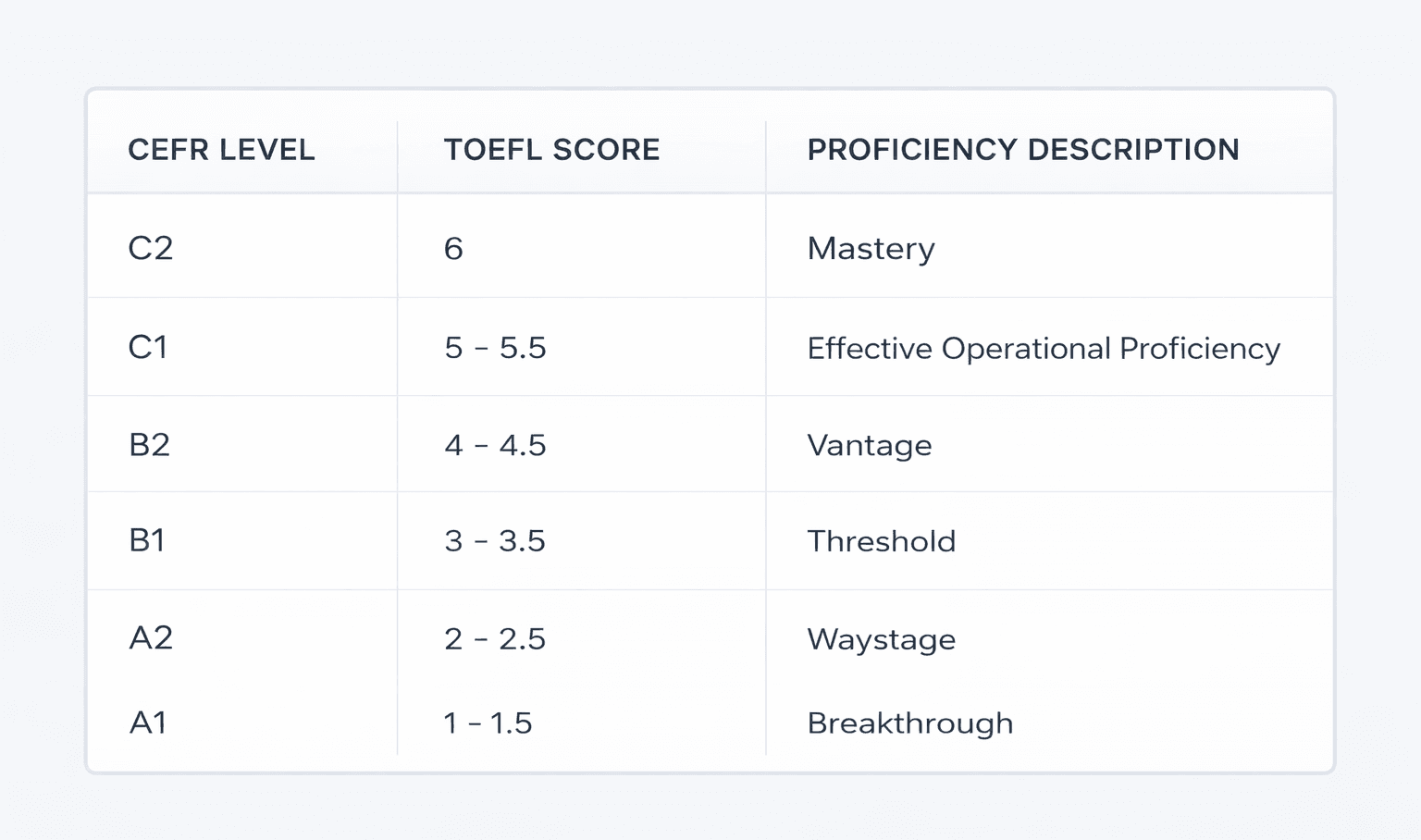
This makes TOEFL results much easier to interpret for universities, employers, and immigration processes.
3. Adaptive testing in Reading and Listening
Reading and Listening will now use a multistage adaptive format.
What does this mean?
- Everyone starts with a set of medium-difficulty questions
- Based on your performance, the second part becomes more challenging or more accessible
Important to understand:
- Receiving easier questions does not mean a lower score.
The exam adjusts the scoring statistically, ensuring fairness for all test-takers.
4. New question types focused on real usage
Reading: active language use
Some Reading tasks now require you to complete parts of words or phrases based on context. This tests:
- Vocabulary accuracy
- Understanding of meaning
- Written precision
Other texts resemble real academic or professional communication, such as announcements or short informational messages.
Listening: communication awareness
In some Listening tasks, you will choose the most appropriate response, not simply the grammatically correct one.
This evaluates:
- Pragmatic understanding
- Social awareness
- Natural interaction skills
The focus is on how English is actually used, not just rules.
5. Writing: quality over quantity
The Writing section now emphasizes:
- Clear organization
- Appropriate tone
- Coherent ideas
Tasks may include:
- Organizing words into meaningful sentences
- Writing short professional messages
- Contributing to an academic-style discussion
Long essays are less important than clear and purposeful writing.
6. Speaking: accuracy and fluency in real time
The Speaking section includes:
- Tasks that require repeating short statements accurately
- Responses based on personal experience or opinion
This evaluates:
- Pronunciation
- Rhythm and clarity
- Ability to process spoken English quickly
The goal is to assess real communicative competence, not memorized answers.
7. How is the exam scored now?
The TOEFL 2026 uses a hybrid scoring system:
- Artificial intelligence analyzes responses
- Human raters review and validate when needed
This combination ensures:
- Consistency
- Fairness
- High reliability
The scoring system is designed to reflect real language ability, not test-taking tricks.
8. How should you prepare for TOEFL 2026?
Because the TOEFL 2026 focuses more on real communication, preparation strategies must evolve. Traditional study methods based on memorization are no longer enough.
The new exam rewards clarity, control, and confidence, so preparation should focus on developing practical and transferable language skills.
To prepare effectively, test-takers should prioritize:
- Structuring ideas clearly and logically
- Using vocabulary naturally and accurately in context
- Improving pronunciation and listening precision
- Writing concise, well-organized responses
- Practicing real communication rather than memorized answers
Instead of isolated grammar exercises, preparation should involve holistic language development. This includes engaging in conversations, interacting with authentic spoken and written English, and practicing tasks that integrate multiple skills at the same time.
With the new TOEFL format, activities such as listening and responding, reading and summarizing, or expressing opinions clearly under time pressure become essential training tools.
Adapting to the new exam format
Preparing for TOEFL 2026 also requires a proactive mindset. Staying informed about the changes, adjusting study habits, and choosing the right preparation resources will make a significant difference.
Many institutions and platforms are updating their materials to align with the new format, and new practice tests and workshops are becoming available. However, access to resources alone is rarely enough to achieve strong results.
Strategic guidance can help test-takers focus on the skills that truly matter, avoid common preparation mistakes, and develop a clear, effective study approach based on their real level and goals.
Ultimately, success in TOEFL 2026 depends on building real, usable English — the kind of English that works confidently in academic, professional, and international environments.

9. Final thoughts
The TOEFL 2026 represents a meaningful shift in how English proficiency is assessed. The exam is now more realistic, more aligned with international standards, and more focused on authentic communication.
In this new format, success no longer comes from shortcuts or memorized strategies. It depends on developing real language skills — the ability to understand, express ideas clearly, and communicate with confidence in real academic and professional situations.
If your goal is to study, work, or move abroad, preparing strategically for TOEFL 2026 is no longer optional. It has become an essential part of building opportunities and accessing international paths.
By understanding the changes, adapting your preparation approach, and practicing consistently, you can turn this new exam format into an advantage rather than an obstacle. The TOEFL 2026 rewards those who focus on clarity, control, and meaningful communication — skills that extend far beyond the test itself.

About the author
Bastian Agudelo is a language coach specialized in English and French, working with professionals, students, and medical doctors who aim to study, work, or migrate abroad, or advance confidently in their international careers. His approach focuses on clarity, structure, and real-world communication, helping learners perform effectively in professional and international assessment contexts.